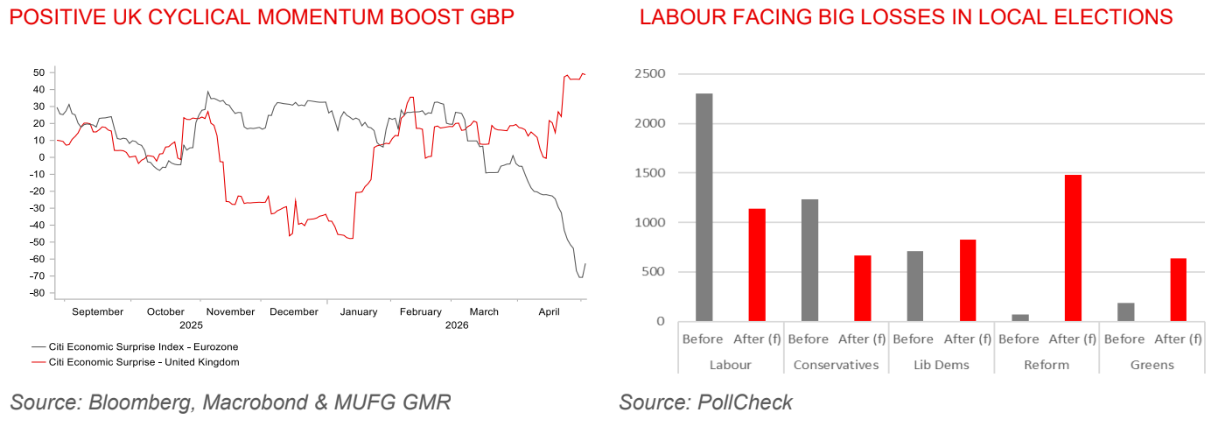
The GBP has continued to trade within narrow ranges against the major currencies of the EUR and USD over the past week. Cable reached a high of 1.3658 on 1st May but has since slipped back towards the 1.3500 level. At the same time, EUR/GBP has continued to grind lower, moving back towards support near recent lows just above 0.8600. Last week's Bank of England policy update failed to provide a fresh catalyst for near-term GBP direction. While UK rate markets have scaled back expectations for near-term BoE rate hikes following the latest policy communication, this adjustment has not translated into a weaker GBP. Markets are assigning just over a 50:50 probability to a rate hike in June, down from around 80% ahead of last week’s MPC meeting. For 2026 as a whole, however, around three rate hikes remain priced in.
Governor Bailey described the initial market response to the Bank’s policy update as "very sensible", implying satisfaction with current market pricing. This was pricing he had earlier encouraged by stating that the BoE was not sending a "clandestine message" that interest rates would rise. He also noted that much of the required policy tightening had already been delivered via tighter financial conditions. The upward shift in market expectations for interest rates has tightened financial conditions, helping to contain inflation pressures without the immediate need for further rate hikes. The BoE highlighted that the market-implied path for Bank Rate has shifted higher by around 55bp on average over the next three years. This would offset much of the required tightening under scenarios A and B, where the Bank's models and rules suggest between 0-75bp of tightening is needed. Scenario C, however, would still require a more forceful response of around 50-150bp. In our updated forecasts, we expect the BoE to validate the hawkish shift in market expectations and follow through with around 50bp of rate hikes, assuming the worst-case Scenario C is avoided. We expect the BoE and the ECB to deliver a similar amount of tightening, contributing to a more stable EUR/GBP range between 0.8600 and 0.8800. EUR/GBP may test the lower end of this range if financial market volatility remains low and supportive of GBP carry demand.
Domestic UK politics is one potential trigger for a pick-up in near-term GBP volatility, alongside ongoing developments in the Middle East. UK local elections are scheduled for Thursday 7,n May, with more than 5,000 council seats being contested across 136 local authorities in England. Elections are also being held on the same day for the Scottish Parliament, the Welsh Senedd and six directly elected mayors in England. These local elections may attract more market attention than usual given Prime Minister Keir Starmer’s precarious political position. The Labour Party is expected to suffer significant losses, with polling experts forecasting that it could lose 50-75% of the seats it is defending (around 1,500-1,900 councillors). This could mark Labour’s worst-ever local election performance in vote-share terms. Such disappointing results, if confirmed, would heap further pressure on Prime Minister Starmer, whose net approval rating remains deeply negative at around -40 to -45. making him one of the least popular UK prime ministers at this stage of the political cycle. While the sharp downward momentum in his ratings has eased slightly, his leadership remains vulnerable to a poor set of local election results.
We see a number of potential scenarios following the local elections. In the first scenario, the Labour Party suffers heavy losses of around 1,200-1,500 councillors. Reform UK and the Green Party make significant gains, but Labour remains broadly competitive at the national level. Prime Minister Starmer moves quickly to acknowledge the “difficult results'' and signals a policy reset. He survives as Prime Minister, but with his authority diminished. In this scenario, Labour MPs prioritise leadership stability and there is no obvious successor able to command sufficient support within the party. The response is largely contained to a cabinet reshuffle. As a result, the local elections would have only a limited impact on the gilt market and GBP. We view this outcome as the current base-case scenario. Polymarket is currently assigning around a 40% probability to Starmer losing his position by June, rising to around 68% by December.
However, if the Labour Party were to suffer even larger losses of around 1,700-2,000 councillors including the loss of major councils in London and the North. Prime Minister Starmer would find it much harder to survive beyond the short term. Such an outcome could trigger a leadership challenge, requiring the backing of at least 20% of Labour MPs (81 MPs). In this scenario, Prime Minister Starmer could choose to announce that he will step aside once a successor is selected, or a formal leadership contest could be initiated. A new leader could potentially be in place by the Labour Party’s annual conference in late September. The main potential leadership challengers include Health Secretary Wes Streeting, former Deputy Prime Minister Angela Rayner, and Greater Manchester Mayor Andy Burnham, although Burnham would first need to return to Parliament in order to participate in a leadership contest. Gilt yields and GBP would likely react more negatively if heightened political uncertainty were accompanied by increased fiscal risks, particularly in the event that Labour were to shift towards a more left-leaning leader such as Rayner or Burnham. Looking at current FX options market pricing, market participants do not appear overly concerned about immediate downside risks for GBP ahead of the local elections. This aligns with our base-case view that Prime Minister Starmer is likely to suffer political damage but ultimately struggle on as leader, thereby limiting the near-term negative fallout for gilts and GBP. Nevertheless, poor local election results combined with Starmer's continued low approval ratings would be likely to sustain speculation over his longer-term future.