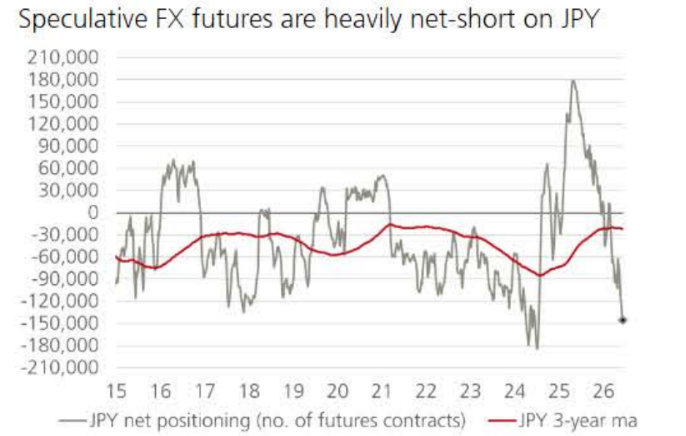
Against this backdrop of narrowing US-Japan yield differentials, coupled with short-yen positioning having reached stretched levels, we believe the risks for USDJPY still look skewed to the downside. At the same time, we acknowledge that the Fed is likely to stay hawkish in the short term amid elevated inflation and a strong growth backdrop in the US. So, our US economics team recently pushed out the timing for the next Fed rate cuts by one quarter to March 2027 and June 2027 (from December 2026 and March 2027). Taking this into account, we moderately raise our USDJPY targets to 158, 156, 154, and 152 for September, December, March 2027, and June 2027 respectively (from 156, 154, 152, and 150 previously).
For USD-based investors, we think the expected total return of holding yen cash is unappealing given the low interest rates. We like to take on yen exposure via the stock market, and we rate Japanese equities as Attractive in our global preference. For JPY investors, given low domestic interest rates, we favor yield pickup strategies to sell downside risk in AUDJPY at levels below 111 for one-month, given our positive view for the AUD to be an outperformer within G10 currencies.