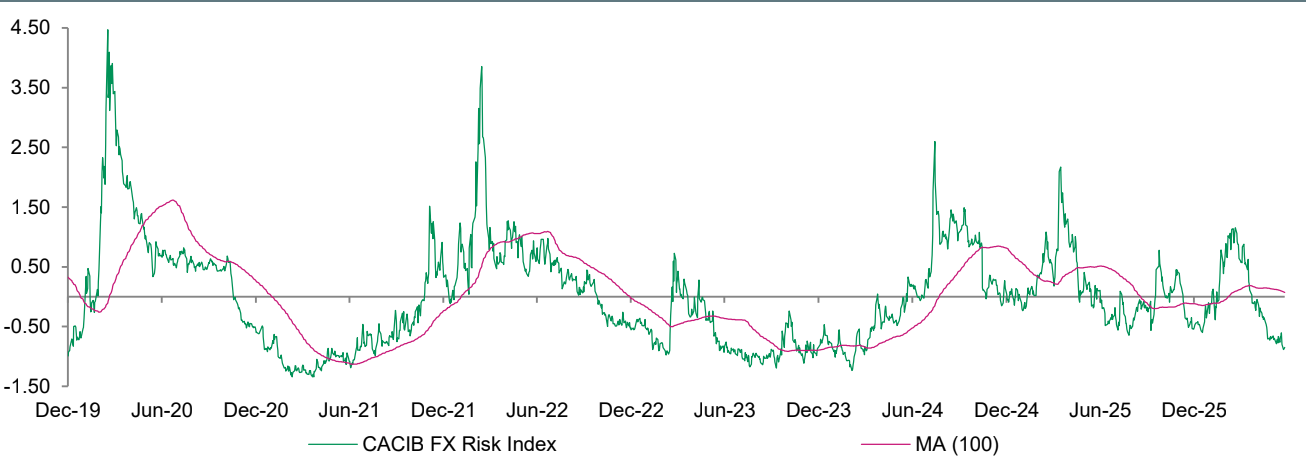
Credit Ágricole: FX Risk Index - FJElite
- At -0.8488 (vs -0.6584 last week) our Risk Index has reached its lowest level since early 2024. The trend in the Index has also turned lower and threatens to turn negative for the first time since the beginning of the US- Iran war.
- The US and Iran signing a deal to extend their ceasefire another 60 days and re-open the Strait of Hormuz has boosted risk sentiment. Brent crude oil prices have dropped below USD80/bl for the first time in three months lowering investor concerns about inflation and dragging global rates lower.
- While the details of the US-lran deal have not been officially released, newswire reports are that it includes Iran's right to sell oil immediately on the signing of the deal this Friday, tap a USD300bn development fund and eventually get access to its frozen assets. All of this will be contingent on Iran’s compliance with the restrictions on its nuclear programme to negotiated over the coming 60 days.
- Whether the deal holds is a potential flashpoint for markets. Iran insists Lebanon is included in the ceasefire and claims Israel continues to violate this ceasefire. Iran is threatening Israel with a harsh response, while US President Donald Trump says “(Israel) has to be more responsible” in Lebanon.
- Whether the retreat in global rates with lower oil prices can be maintained will be another factor affecting risk sentiment. The market is expecting a less hawkish FOMC under its new Chair Kevin Warsh. If Warsh fails to sound dovish later today, this could upset sentiment.
- Lower equity and FX market volatility as well as the outperformance of defensive stocks by cyclical stocks are dragging our Risk Index lower. Supporting the Index are rising credit spreads and gold prices.
- Among G10 currencies, only the CHF and CAD have significant positive correlations with our Risk Index, while the GBP has a significant negative correlation with the Index.