Berenberg on UK's Next Labour PM Burnham - FJElite
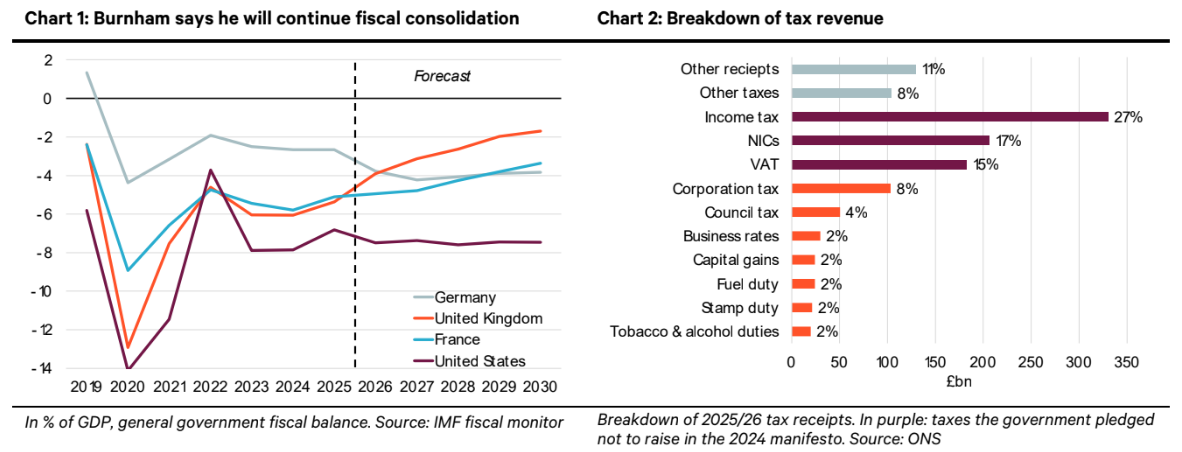
Sticking to the rules: Burnham has reassured investors. He has recommitted to the government’s current fiscal targets of covering all day-to-day spending with tax revenue (ie running a current budget surplus) and the debt-to-GDP ratio falling in 2029-30. If achieved, this would keep the UK on a path of fiscal consolidation that sets it apart from most other advanced economies - see Chart 1. He has also recommitted to the Labour manifesto promise not to raise value-added tax (VAT), income tax or national insurance contributions (NICs). In the latest official government forecast published by the Office for Budget Responsibility (OBR) in March, the government met both fiscal rules by 0.7% of GDP, or £25bn. If the OBR re-ran its forecast today, we suspect that the rise in market interest rates and government bond yield expectations since and higher defence spending would halve the “headroom”, to £i3bn.
Giveaways and tax cuts: The incoming administration aims to improve household finances and help high street businesses immediately. However, limited scope to increase spending appears to have resulted in piecemeal policy proposals, including:
- subsidies for energy bills and public transport fares. Outgoing Chancellor Rachel Reeves announced a similar policy in her last budget, so we know a £90 reduction in annual household energy bills costs £2.5bn per year;
- a rise in business rates on distribution warehouses to cut business rates for high street premises; and
- a partial reversal of the April 2025 increase in employer national insurance for hospitality and/or small businesses. A full reversal of the tax hike on the hospitality sector would relinquish c£i.sbn a year of tax revenue.
Revenue-raising options: The above tax cuts and spending giveaways only total about £5bn, which keeps them affordable within the fiscal rules. However, adverse economic developments or new spending requirements could easily prevent the fiscal deficit from narrowing as planned. If so, the government would have to find revenue outside of the largest three taxes, which it has promised not to raise - see Chart 2. A recent paper from one of Burnham’s closest advisers indicates that any tax increase would be levied on wealth rather than income.